Tuesday, August 4, 2009

Pool Table Lamp Repair

If you saw your lamp, with a gap like this, hanging from above your kitchen table, would you be concerned? Well my customer was!

After having the electrician remove it, he brought it to my studio. I must tell you that I let it sit on the workbench for a few days before I even got up the nerve to touch it.

First I removed the top pieces that would allow me to get to the trouble area.

Then I removed all the copper foil from the effected area and cleaned the glass. When I removed the old foil and solder, this helped to close the gap.

The pieces were then all refoiled. My favourite tool (the two inch thick telephone book) was placed on the crown of the lamp over night to put just enough pressure to help gravity move things back in place.

The next day I began soldering. This was one of the more challenging soldering jobs that I had done. Because of the angle of the lamp, the hot solder wanted to roll off. I turned the temperature controller on the iron down a little lower than normal so that the flow of the solder could be managed better. Because of the size and weight of the lamp, it was a feat to turn the lamp over. And without a jig, it was tricky to hold it in place at the correct angle for soldering the inside of the lamp. Have I ever told you, I thrive on a challenge?

My main concern in repairing the lamp is that it would be safe to hang back up. I had thought about what extra support I could add. When I removed the old foil, I discovered a wire that had been soldered from cross bar at the top of the lamp and followed the solder line down the lamp to the bottom. This guide wire is what kept the lamp from falling to the floor. It also allowed the lamp to come apart without breaking the glass pieces. So obviously, this wire got soldered back into place as it had been. If it served it's purpose the first time, it was definately an essential part of the design. Once again, a learning experience for me.


Saturday, August 1, 2009

Classes Fall 2009

All classes must be paid in full one week prior to the event. Once the class is paid for, your spot is reserved. You can pay by cash, cheque or credit card at Trickett Glass Studio or mail payment to PO Box 200, 214 Upper Queen St, Thorndale, ON N0M 2P0. This payment is non-refundable and ensures commitment to participation.

Wednesday, Sept 16, 2009, 9am-4 pm
Beginner Stained Glass Class

Introduce yourself to a new hobby! You will learn all the skills to create your own stained glass project using the copper foil technique. This is an entry level one day workshop. No prior experience or artistry is required.$70.00 plus PST ($75.60 CAD) includes the materials for the project and the use of the tools. Please bring safety glasses if you have them, suitable shoes for standing and a bag lunch.

Tues & Thurs, Nov 3 & 5, 2009, 7-9 pm
Stained Glass - The Next Step

This two evening class is designed for those who have taken a beginner class in the past either at Trickett Glass or elsewhere who have not progressed further but would like to. We will review the basic steps of cutting, grinding, foiling and soldering. There will be lots of time for specific questions. We will watch video clips and you will be given patterns to take home. We will also discuss workshop set up ideas and the option for renting studio time at Trickett Glass. The cost for this class is $40 plus PST ($43.20 CAD).

Saturday, Nov 7, 2009, 9 am-4 pm
Beginner Stained Glass Class

Introduce yourself to a new hobby! You will learn all the skills to create your own stained glass project using the copper foil technique. This is an entry level one day workshop. No prior experience or artistry is required.$70.00 plus PST ($75.60 CAD) includes the materials for the project and the use of the tools. Please bring safety glasses if you have them, suitable shoes for standing and a bag lunch.

Saturday, Nov 21, 2009, 12:30-4pm
Fused Wind Chimes Class

This is a fun, quick introduction to fusing. You will learn how to cut the glass strips, prepare them for the kiln and fuse them. Cost is $50.00 plus PST ($54.00) and includes all materials and tools. Please bring comfortable shoes. Windchimes can be picked up at the studio during the following week.


Saturday, Dec 5, 2009, 12:30-4 pm
Snowflake Class

No previous experience is necessary to take the snowflake course. Register soon as four students is the limit. Cost is $45.00 plus PST ($48.60 CAD) and includes all materials and tools. Please bring comfortable shoes. We will all be making the same design but you can choose the colour of globs.

Friday, April 17, 2009

I Want More

Have you ever had a real appetite for something? You crave it so much that the thought of it consumes you. And when you get a taste of it ... you want more. Sure, I feel that way about chocolate ice cream some times, but I also feel this same passion for glass work. It began when I signed up for a beginner class, then took up stained glass as a hobby. Soon people were making specific requests of me and the hobby blossomed into a part time business. As the love affair with glass continued and the opportunity arose, I jumped into the glass business full time. This is the second year that I've been running Trickett Glass full-time. I'm thankful to be able to pay the bills and to make a living while doing what I love, but ... I want more.

As an entrepreneur who is building a business, paying the bills is not enough. I want more. I want to learn. I want to develop relationships with my clients. I want to network with other business owners. I want to share my knowledge.

When the internet (the world wide web) was born, it was promoted as "The Information Highway". This is so true today. I feel we are bombarded by information on the web, whether we want to be or not. But when I want to research a topic on the net, I am usually amazed at how much information is available. For most businesses, if you are not promoting your business on the internet, you are missing out on additinal business. Lately I've been asking myself, "How can I grow my business, with the help of 'The Information Highway'?" There are so many opportunities, it's hard to know where to start. Over the last couple of months I have sought out direction and prayed for wisdom in this regard.

Here are two of the building blocks that I am going to put in place in the coming months to position Trickett Glass for more success on the internet. These same steps could be applied to any small business who has an appetite to grow.

Most importantly, my website needs a fresh makeover. Over the past few years it has fulfilled it's purpose, but business needs are changing. It needs to be more customer interactive. If I want to build relationships with my clients, the website needs to encourage this. An email opt-in allows a business owner to be able to communicate with those who visit the site and want to know more. Shopping carts allow the option for customers to purchase online and makes your products available to those who are unable to visit your physical retail store. Videos and ebooks are a wonderful learning tool to assist in distance learning. There really is no excuse for not having an attractive, informative and engaging website.

Any small business owner wears many hats. Besides making and selling stained glass panels, I also promote my business, keep my books, make deposits, purchase materials, pay suppliers, ship orders, teach classes, print flyers, attend shows and seminars, quote on potential orders, price products, arrange displays, answer the phone, emails and snail mail, etc. Makes me tired just thinking about it. No one works harder than an entrepreneur! A friend of mine who is also an entrepreneur kept telling me to, "Work smarter not harder." I guess it has taken me awhile to catch on, because I still hear this phrase quite often. The second building block that I am installing is using automated systems. Many things that you do repeatedly can be automated. Here are some of the systems that I'm considering: http://www.infusionsoft.com/, http://www.constantcontact.com/index.jsp, and http://www.aweber.com/. Why spend valuable time doing things that you don't need to do? Along the same line, maybe you can't automate something but you can deligate someone else to do it. You might want to consider hiring a Virtual Assistant. Wikipedia describes a Virtual Assistant as "an entrepreneur who provides professional administrative, technical, or creative (social) assistance to clients from a home office. They usually work for other small businesses, brokers and consultancy groups".

These two building blocks are only the beginning. I'll share more in a future blog about promoting your business online, driving traffic to your website, analysing, etc. Do you want more for your small business? Do you have a craving to dive into entrepeneurship? What's holding you back? Go for it!

Sunday, March 29, 2009

Helpful Tips

Other than my first project in stained glass, and a fused glass course, I have been very much self taught over the last 16 years. Many times I have felt that stained glass retailers did not want to give up information unless you bought a class from them. This is very sad. Well, with the development of the internet and many wonderful glass sites and forums, this is slowly changing. And I certainly would never paint all glass artists with the same brush. I'm know that I am not the only one with a passion to learn and a passion to teach. What a rewarding experience to be able to give someone the information to make a process easier or teach them a new approach that will open up new possibilities.

Here are a couple of tips that I learned recently that I want to pass on to you. It is my hope that practical ideas in my blog will be a help and therefore a blessing to you.

There are many ways to cut sheets of glass such as with running pliers or over the edge of a table, but a more reliable way that I've learned from a local retailer is to use a wooden yardstick. I score the glass with my cutter and then place the glass over a yardstick centering it over the score. With light pressure I push with my hands on either side of the yardstick. Always wear safety glasses to protect your eyes.

As stained glass artists something we do quite often is write on glass with a permanent marker, either tracing a pattern piece or labeling the identification of the glass. Usually, the marker just wipes off easily with a little moisture. When the marker has sat for a long period of time and just won't come off, try an eraser. This exact situation happened to me one day when my step son was visiting. Thanks Jay for the tip; it has worked great for me.

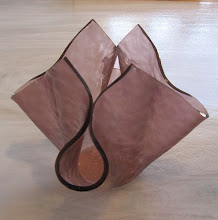
And the third tip today, I picked up from Dayle, a stained glass mentor of mine. Sometimes you want to do something a little different from the norm. These candle shelters with a "textured" solder appearance are an example of this. The textured effect on the solder is made by lightly applying a relatively damp sponge to the surface of the bead shortly after drawing it. Try it a few times until you achieve the desired effect to become familiar with how wet the sponge has to be and how hard you have to press it into the soft bead.

Will any of these tips help you? Feel free to comment and let us know. And if you have a glass related tip to share, please tell us about it.

Sunday, March 8, 2009

Fusing; An Introduction

Fusing is simply melting glass pieces together in a kiln. Fusing also includes the shaping of fused glass. The purpose of fusing is to combine individual pieces of glass placed either beside or on top of each other into a solid final piece.

When you heat glass it softens. Increasing the heat will allow the glass to become fluid and flow together. When glass is heated and cooled properly, the result is a fused piece of glass that is solid and unbroken. Not all glass can be fused together, it has to be compatible. Glass expands when it is heated and contracts when it is cooled. In order to fuse pieces of glass together they must expand and contract at the same rate, so that the glass does not crack.


Slumping uses heat to bend or shape the glass. Often slumping is accomplished by using molds, heating the glass until it drops into the mold. You can also slump glass over a mold to create wavy sides. This is called draping.


Want to learn more? Beginner Fusing Workshop-Thorndale, ON

May 23, 2009; 9 am – 4 pm
Design and make 2 - 4" tiles in this fusing workshop. Learn the basics of fusing including kiln programming, glass compatibility and fusing cycles. Work with glass frit, stringers, iridized and dichroic glass. Projects will be available to pick up one week after the class. All materials and supplies are included. Please bring safety glasses if you have them, suitable shoes for standing and a bag lunch.
Cost is $75, plus PST.

http://www.trickettglass.ca/

Saturday, February 28, 2009

Wall Plaques for Kids

When my grand girl wanted to celebrate her 12th birthday with her friends making garden stones, I agreed. I've taught many adult classes but this was the first one for kids. What a riot! The girls had been previously warned within an inch of their lives about the dangers of working with glass. So when they arrived at Trickett Glass Studio, I just had the joy of guiding them through the project.

All the girls agreed that they wanted to include mirror in their projects and they wanted to hang them on their wall. This just meant that they made them thinner (lighter too) and put a hook on the back. Instead of garden stones they became cement plaques.

So here's the process they followed. First they cut clear mac tac to fit into the bottom of the mold. This held the decorative pieces in place when the cement was poured. The second step was for the girls to arrange the pre-cut glass pieces, mirror and coloured globs in a pattern on top of the mac tac. Thirdly they mixed the cement compound and water until it became the consistency of a milkshake. Carefully they poured the concrete over their design until it became the thickness that they preferred. Then finally they placed a hook in the cement securing it with tape until the plaque dried.
Then the group of girls enjoyed supper and cake while their projects were drying. About two hours later they were able to pop the plaques out of the mold, peel the mac tac off and clean up the front. The project does need to cure so it does need to be handled carefully and should be flipped occasionally for a few days until it is completely dry. If you do put it outside, it should cure first inside for 4 weeks.
Trickett Glass is open to receive all groups for specialized classes whether you are young or young at heart. You can contact Carol through the website http://www.trickettglass.ca/.

Friday, February 20, 2009

American Robin

So, this is what the finised project, "American Robin" looks like. I decided with all the detail that it would be a shame just to sell this as a suncatcher so I made it into a small panel, dressing it up with bevels. The oak frame just completes it. Because of the rust coloured breast and colour of the frame, I chose to use copper patina on the solder.